Restarting my blog is kind of like stepping out of a six-month whirlwind of loan forms, catalog records, and acid free tissue paper. I am not entirely sure where to begin. It's even more difficult because I cannot actually blog about what I do at my job. Working for a metropolitan government museum there are very strict rules about social networking sites. Everything must be approved and double-approved, so rather than go through that mess of paperwork I think I'll continue my adventures by sharing tales of my brave exploits to other museums and my opinions on major developments in the museum world. Maybe even some fun tales about exploring Nashville, TN.
I apologize for such a long delay. Moving to Nashville and settling into a new job and making new friends has taken up the vast majority of my time, and it's all been so wonderfully exhausting. In six months I have gained so much more work experience and engaged in several new amazing projects and activities. I've coordinated loans and gone on my first courier trip and installed exhibits and deinstalled exhibits and went to AAM and joined a book club and gone swing dancing and run a 5K (well, I ran most of it). Whew!
So here we are at the continuation of an adventure. Sit back and enjoy the read.
Sunday, July 28, 2013

Sunday, January 27, 2013
Numbering Objects
Numbering objects is an important part of collections care and documentation. It can also be a bit nerve-racking, cause you don't (and I most certainly don't) want to do it incorrectly. In addition to the standard need to handle objects safely, there is also the need to number things properly and legibly. The object numbers are no good if future collections managers cannot find them, read them, or even alter them. They need to be permanent but removable; an oxymoron I know, like caffeine free Mountain Dew, but that's the way object numbers should work. Here are some useful links, that I found most helpful, about applying numbers to objects:
http://www.collectioncare.org/cci/ccin.html
http://www.powerhousemuseum.com/pdf/preservation/A_Simple_Guide_to_Lablling_Museum_Objects.pdf
http://www.collectioncare.org/cci/ccin.html
http://www.powerhousemuseum.com/pdf/preservation/A_Simple_Guide_to_Lablling_Museum_Objects.pdf
Monday, December 31, 2012
Intermission
Greetings one and all from the buckle of the bible belt. Apologies for the continued lack of postings. I have been extremely busy with moving and preparing for the new job. Once I have settled and start working, I'll be back to blogging. I promise!
Cheers all and Happy New Year!
Here is some intermission music. Enjoy!
Cheers all and Happy New Year!
Here is some intermission music. Enjoy!
Saturday, December 1, 2012
A New Job!!!
Hi all! I apologize for the lack of recent postings. I have been extremely busy lately with interviews and trips, and I have some very happy news. I finally landed the dream job. I am the new Registrar at the Parthenon in Nashville, TN. I am so happy and excited that all of my hard work has finally paid off and I look forward to starting this exciting new chapter in my life. Thank you to all of my readers and friends for sticking in there with me and sharing your comments.
Now here we are at the start of a new adventure. Nashville here I come!
Now here we are at the start of a new adventure. Nashville here I come!
Saturday, November 10, 2012
Federico Barocci: Renaissance Master
In the summer of 2008, oh so many moons ago, I interned at the Saint Louis Art Museum as a curatorial research assistant. I spent three months reading and thinking of nothing but Federico Barroci, an Italian Renaissance artist who was born and died in Urbino, Italy (c. 1526 - 1612). While he is not a widely known artist in modern times, Barocci was one of the most influential artists of the 16th and 17th centuries. His mastery of color and the vast collection of preparatory drawings he left behind, show him to be one of the most creative and methodical artists of his time. Due to this, Dr. Judith Mann of the Saint Louis Art Museum decided it was high time that this relatively unknown master get a little bit of the spotlight. After many years of planning and preparation on behalf of museum staff, external curators, and dozens of interns, the show is finally here. Read more about it at the online at Federico Barocci: Renaissance Master.
After four years of waiting, I was happy to see Judy's show finally come to fruition. I made my way up to the museum Thursday to see the exhibit with great anticipation and I was not disappointed. I began by taking up my audio tour and entered into the introductory gallery. Here I was met by a self-portrait of the man himself. His soft brown eyes glowed out at me, inviting and warm, and if I hadn't of liked him already his portrait would have definitely won me over. The way he captured his own gaze in oils and pigments shows, in many ways, how he saw the world and thus why he portrayed it the way he did in his art. The audio guide introduces the viewer to Barocci and the show, as well as all the contributors and sponsors of the exhibit. Then I was introduced to the first of many Barocci preparatory drawings, over a hundred, which make up the vast majority of the show.
The large number of drawings and cartoons in the show are, in my opinion, what make it so great. While it is always awe inspiring to see a completed work on a grand scale, I personally have always been more interested in the creative process of such grand pieces. I like to see how the characters of each painting were developed and shaped. This is why Barocci is the best subject for such a show, since he has left behind probably more preparatory drawings than any other Renaissance master. Here you can see Barocci's processes, which figures he struggled with and how saints came to their final poses. It's almost like following a timeline of drawings until you come to the culmination; the finished painting, fantastical and towering over you.
Many of Barocci's works are devotional alter pieces and, while looking up at these beautiful compositions, somewhere inside me a younger Maggie in her Catholic school uniform was wondering if she should genuflect. The works and their drawings are astoundingly beautiful. Barocci had this great way of portraying figures' faces, where they seem to glow with an aura all their own. One particularly great set of drawings near La Madonna del Gatto (The Madonna of the Cat), show how the artist developed such a radiant face for the Virgin Mary; first starting with a sketch of an actual model and next to that another sketch where the woman's head has been softened and idealized. His glowing characters are often shown in very innovative poses, which is one of the reasons Barocci was such a groundbreaking artist. Despite this, there is also evidence of his taking ideas from previous masters, such as Raphael (Raffaello Sanzio), also from Urbino. This can be seen when comparing Barocci's Entombment with Raphael's The Deposition (not included in show). And these are just a couple of examples of some of Barocci's works on display in this exhibition.
The thoughtfully planned layout of the exhibit allows visitors to stroll through and take in all the drawings and their paintings, one at a time. The audio guide provides information on each painting and covers anywhere from three to five drawings per piece. The exhibit also has ample text in the form large panels and individual labels. In some areas, magnifying glasses are provided that enable visitors to get a closer look at prints and drawings. There is also an information video in one of the galleries, where curators and museum directors explain more about Barocci, his life, his techniques, and his art. I can grantee that by the time the visitor exits this exhibit they will know so much more about the artist and his process. So much so, they'll be wondering how they had never even heard of Barocci in the first place.
Federico Barocci: Renaissance Master is an excellent exhibition that allows visitors to not only look at exceptional devotional artworks but also allows them to see how those artworks were developed. It displays Barocci's skills as a painter, printer, and draftsman. I highly recommend this exhibit to anyone who is passionate about art and the artistic process.
After four years of waiting, I was happy to see Judy's show finally come to fruition. I made my way up to the museum Thursday to see the exhibit with great anticipation and I was not disappointed. I began by taking up my audio tour and entered into the introductory gallery. Here I was met by a self-portrait of the man himself. His soft brown eyes glowed out at me, inviting and warm, and if I hadn't of liked him already his portrait would have definitely won me over. The way he captured his own gaze in oils and pigments shows, in many ways, how he saw the world and thus why he portrayed it the way he did in his art. The audio guide introduces the viewer to Barocci and the show, as well as all the contributors and sponsors of the exhibit. Then I was introduced to the first of many Barocci preparatory drawings, over a hundred, which make up the vast majority of the show.
The large number of drawings and cartoons in the show are, in my opinion, what make it so great. While it is always awe inspiring to see a completed work on a grand scale, I personally have always been more interested in the creative process of such grand pieces. I like to see how the characters of each painting were developed and shaped. This is why Barocci is the best subject for such a show, since he has left behind probably more preparatory drawings than any other Renaissance master. Here you can see Barocci's processes, which figures he struggled with and how saints came to their final poses. It's almost like following a timeline of drawings until you come to the culmination; the finished painting, fantastical and towering over you.
Many of Barocci's works are devotional alter pieces and, while looking up at these beautiful compositions, somewhere inside me a younger Maggie in her Catholic school uniform was wondering if she should genuflect. The works and their drawings are astoundingly beautiful. Barocci had this great way of portraying figures' faces, where they seem to glow with an aura all their own. One particularly great set of drawings near La Madonna del Gatto (The Madonna of the Cat), show how the artist developed such a radiant face for the Virgin Mary; first starting with a sketch of an actual model and next to that another sketch where the woman's head has been softened and idealized. His glowing characters are often shown in very innovative poses, which is one of the reasons Barocci was such a groundbreaking artist. Despite this, there is also evidence of his taking ideas from previous masters, such as Raphael (Raffaello Sanzio), also from Urbino. This can be seen when comparing Barocci's Entombment with Raphael's The Deposition (not included in show). And these are just a couple of examples of some of Barocci's works on display in this exhibition.
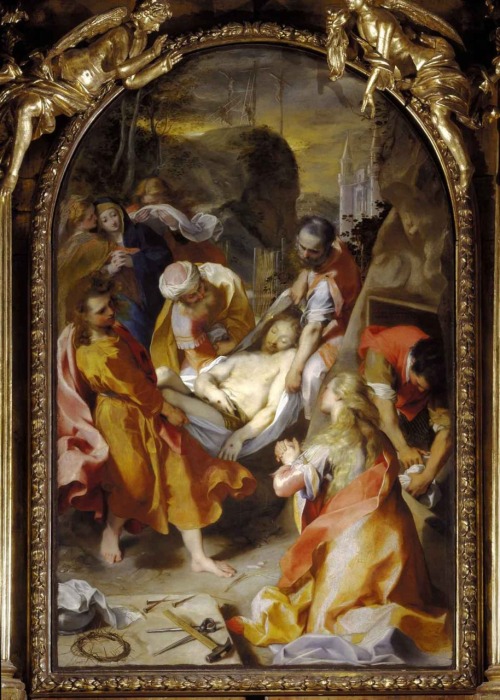
The thoughtfully planned layout of the exhibit allows visitors to stroll through and take in all the drawings and their paintings, one at a time. The audio guide provides information on each painting and covers anywhere from three to five drawings per piece. The exhibit also has ample text in the form large panels and individual labels. In some areas, magnifying glasses are provided that enable visitors to get a closer look at prints and drawings. There is also an information video in one of the galleries, where curators and museum directors explain more about Barocci, his life, his techniques, and his art. I can grantee that by the time the visitor exits this exhibit they will know so much more about the artist and his process. So much so, they'll be wondering how they had never even heard of Barocci in the first place.
Federico Barocci: Renaissance Master is an excellent exhibition that allows visitors to not only look at exceptional devotional artworks but also allows them to see how those artworks were developed. It displays Barocci's skills as a painter, printer, and draftsman. I highly recommend this exhibit to anyone who is passionate about art and the artistic process.
Sunday, November 4, 2012
Remember to Vote Tuesday!
Hi all and apologies for the lack of recent posts. I have spent a lot of time recently working and researching political candidates. Allow me to take a moment to encourage everyone to vote and to be an informed voter. Every election is important and folks should take the time to carefully research and consider each candidate.
I also wanted to share what has been my mantra/power song this election season. This one's for the ladies! Huzzah for 92 years of women voting! Sister Suffragette
I also wanted to share what has been my mantra/power song this election season. This one's for the ladies! Huzzah for 92 years of women voting! Sister Suffragette
Monday, October 22, 2012
Dutch Museum Art Theft
Today I read an article concerning the recent art theft of seven paintings from Rotterdam's Kruntshal Museum that very much reminded me of a blog post I wrote back in May entitled Museum Heists in Movies. You can read the article at cbsnews.com. They even make a Pierce Brosnan reference. Two more articles, one in the Detroit Free Press entitled Dutch Art Thieves were no 'Ocean's 11' Team, and the other in the Washington Post entitled Why do people steal art?, also carry a similar message.
The main point being that museum thefts are not high-tech or cool and art thieves are not classy and sophisticated, they are thugs who steal and break things.
The main point being that museum thefts are not high-tech or cool and art thieves are not classy and sophisticated, they are thugs who steal and break things.
Subscribe to:
Posts (Atom)